The Invention of Tradition
by Lineke Stobbe
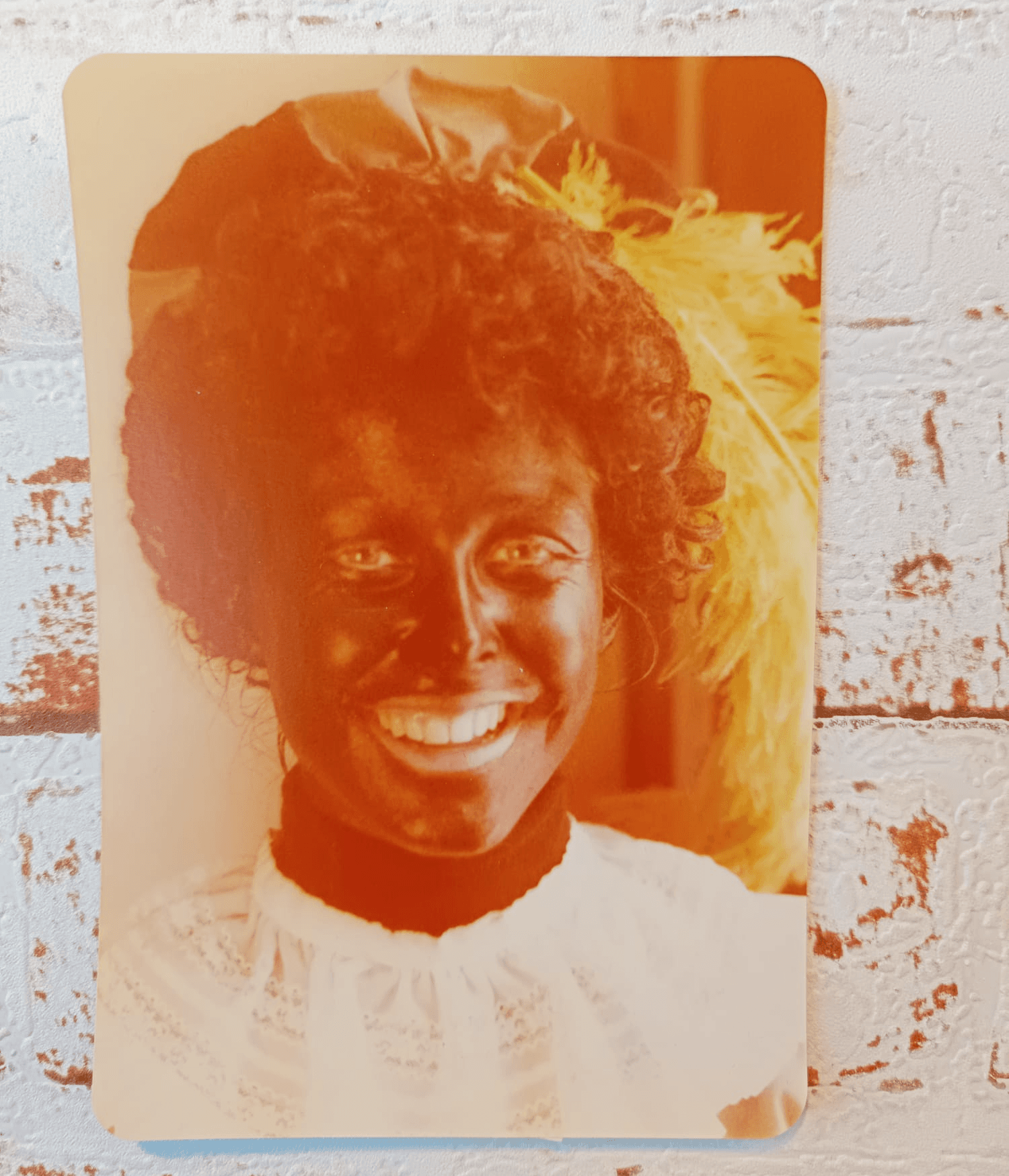
This is me in December 1980, dressed up as Zwarte Piet, a black face character. I was 14 and played the role during the Sinterklaas celebration at the primary school of my father. My father, who has always been very interested in history, raised me with a critical historical perspective. He told me for example that during WW II all trains from Westerbork (the Dutch transit camp) departed ‘on time’ to the Nazi destruction camps.
Yet, I do not recall that the character of Zwarte Piet in the Sinterklaas tradition was questioned. I did sense that it had become ‘lighter’ as my father was still raised with the idea that you had to be a good kid or else Zwarte Piet would put you in the sack. It was not until I started working for GPCM|WHC that I became fully aware of the colonial roots of this tradition. I still recall quite vividly that a colleague (originally from the US) was telling me that she was in shock the first time she was confronted with Zwarte Piet. I started to use the video Why black face is still a part of Dutch holidays in my Diversity and Inclusion classes 15 years ago. In this video, our former Dutch Prime Minister Rutte, says “Black Pete is black. I cannot change that because that is his name. It is an old children’s tradition (…). It is not Green Pete or Brown Pete. It is Black Pete, so I cannot change this.” (2014)
Dutch people say that Sinterklaas is an old tradition and therefore it cannot be changed. Yet traditions are made by people and hence not fixed in stone. Traditions can and do change, because people change.
This is me in December 1980, dressed up as Zwarte Piet, a black face character. I was 14 and played the role during the Sinterklaas celebration at the primary school of my father. My father, who has always been very interested in history, raised me with a critical historical perspective. He told me for example that during WW II all trains from Westerbork (the Dutch transit camp) departed ‘on time’ to the Nazi destruction camps.
Yet, I do not recall that the character of Zwarte Piet in the Sinterklaas tradition was questioned. I did sense that it had become ‘lighter’ as my father was still raised with the idea that you had to be a good kid or else Zwarte Piet would put you in the sack. It was not until I started working for GPCM|WHC that I became fully aware of the colonial roots of this tradition. I still recall quite vividly that a colleague (originally from the US) was telling me that she was in shock the first time she was confronted with Zwarte Piet. I started to use the video Why black face is still a part of Dutch holidays in my Diversity and Inclusion classes 15 years ago. In this video, our former Dutch Prime Minister Rutte, says “Black Pete is black. I cannot change that because that is his name. It is an old children’s tradition (…). It is not Green Pete or Brown Pete. It is Black Pete, so I cannot change this.” (2014)
Dutch people say that Sinterklaas is an old tradition and therefore it cannot be changed. Yet traditions are made by people and hence not fixed in stone. Traditions can and do change, because people change.
Prime Minister Rutte has undergone “major changes” in his position on Black Pete since 2014. In June 2020 he said that he now understood people who feel discriminated against by Sinterklaas's black-faced helper.
While it is assumed that traditions have an ancient history, many traditions have been invented or changed on purpose, whether for political or cultural reasons. So, the figure of Sinterklaas is based on the Greek bishop Nicholas of Myra, who lived in Lycia in Asia Minor at the end of the third and beginning of the fourth century AD and was known for his good deeds. Yet, the role of Zwarte Piet originated only in the 19th century, created by Amsterdam teacher Jan Schenkman, who introduced him in the book Sint-Nicolaas en zijn Knecht (Saint Nicholas and his Servant). Zwarte Piet was an amalgamation of various folklore figures, including the bogeyman, the devil, the Moor, and the chimney sweep. In the book, he became a clownish helper of Sinterklaas, with a typical clothing style based on images of Africans from that time.
So while San-Nicolas/Sinterklaas is an ancient figure known for his good deeds, Zwarte Piet was invented in the 19th century in the image of Africans of that time.
Be critical about your traditions! Be open and learn, show appreciation for how others might feel, and connect with empathy and compassion.
Prime Minister Rutte has undergone “major changes” in his position on Black Pete since 2014. In June 2020 he said that he now understood people who feel discriminated against by Sinterklaas's black-faced helper.
While it is assumed that traditions have an ancient history, many traditions have been invented or changed on purpose, whether for political or cultural reasons. So, the figure of Sinterklaas is based on the Greek bishop Nicholas of Myra, who lived in Lycia in Asia Minor at the end of the third and beginning of the fourth century AD and was known for his good deeds. Yet, the role of Zwarte Piet originated only in the 19th century, created by Amsterdam teacher Jan Schenkman, who introduced him in the book Sint-Nicolaas en zijn Knecht (Saint Nicholas and his Servant). Zwarte Piet was an amalgamation of various folklore figures, including the bogeyman, the devil, the Moor, and the chimney sweep. In the book, he became a clownish helper of Sinterklaas, with a typical clothing style based on images of Africans from that time.
So while San-Nicolas/Sinterklaas is an ancient figure known for his good deeds, Zwarte Piet was invented in the 19th century in the image of Africans of that time.
Be critical about your traditions! Be open and learn, show appreciation for how others might feel, and connect with empathy and compassion.