NARRATIVE ARTIFACT:
Les Ancêtre - The Settlers
NARRATIVE ARTIFACT:
Les Ancêtre - The Settlers
NARRATIVE ARTIFACT:
Les Ancêtre - The Settlers
NARRATIVE ARTIFACT:
Les Ancêtre - The Settlers
Les Ancêtre /The Settlers or (Not) Belonging by Deanne Boisvert
Les Ancêtre /The Settlers or (Not) Belonging by Deanne Boisvert
Les Ancêtre /The Settlers or (Not) Belonging by Deanne Boisvert
Les Ancêtre /The Settlers or (Not) Belonging by Deanne Boisvert
“The first record of Etienne De Nevers' presence in New France is in Trois-Rivières (an outpost upriver from
Quebec City, about half-way to Montreal), on January 15, 1650. On this occasion he was godfather to an
Amerindian child named: Etienne, son of Kaouboukouchich (the father) and Kouekassouekoue (the mother).
The baptism was performed by the Jesuit priest Pierre Bailloquet.” (Geni, 2025, “Étienne Denevers, Sieur de
Brantigny” section).
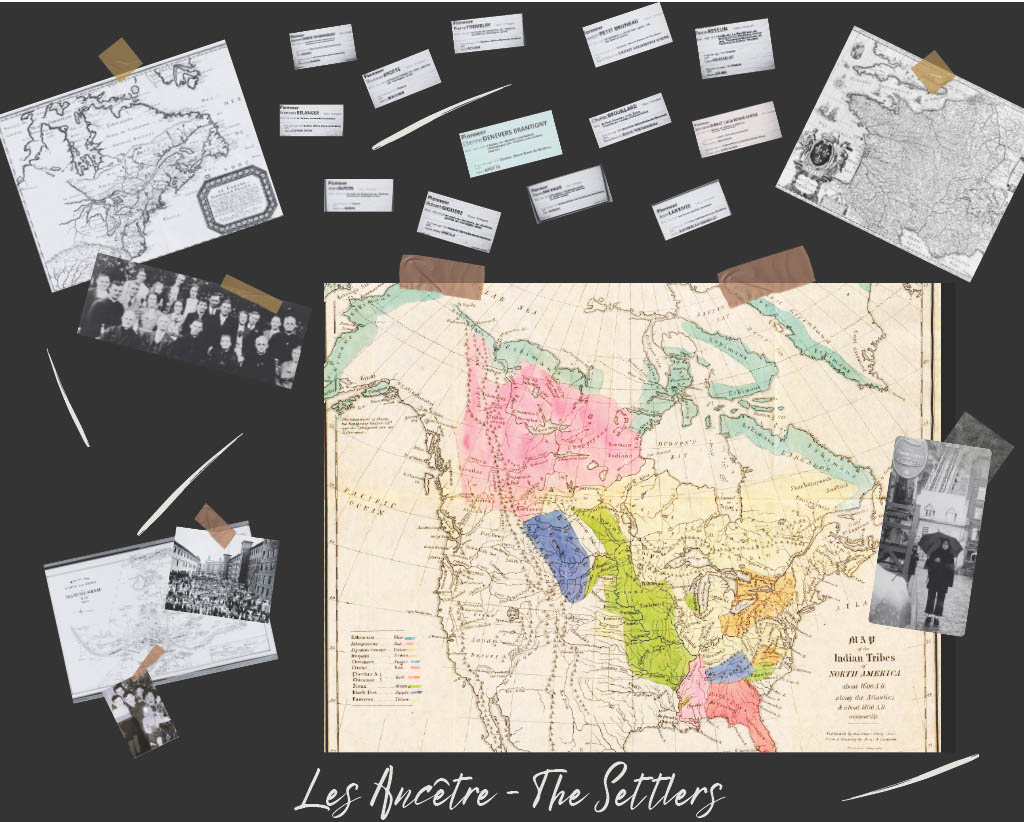
My collage attempts to show that I am a direct descendent of the first settler-colonists from France to
the “New France” regions of Canada – the so called “pioneers”; who mostly arrived in the mid-17th century. This
included Etienne De Nevers Brantigny whose son, Etienne Denevers “dit Boisvert,” gave my family our surname.
However, from a young age, I’ve been aware that the places I grew up belonged to other peoples like the Eastern Band of Cherokee, Menominee, Lumbee, and the Iroquois Confederacy, particularly the Oneida. If I forgot that the hills, river, streams, lakes, and forests of my childhood belonged to the Indigenous people, this historical marker near one of my childhood homes always reminded me.Thus, this collage also seeks to acknowledge the Indigenous peoples of North America with the colored map marking their homelands at the time my French ancestors migrated there.
“The first record of Etienne De Nevers' presence in New France is in Trois-Rivières (an outpost upriver from
Quebec City, about half-way to Montreal), on January 15, 1650. On this occasion he was godfather to an
Amerindian child named: Etienne, son of Kaouboukouchich (the father) and Kouekassouekoue (the mother).
The baptism was performed by the Jesuit priest Pierre Bailloquet.” (Geni, 2025, “Étienne Denevers, Sieur de
Brantigny” section).
My collage attempts to show that I am a direct descendent of the first settler-colonists from France to
the “New France” regions of Canada – the so called “pioneers”; who mostly arrived in the mid-17th century. This
included Etienne De Nevers Brantigny whose son, Etienne Denevers “dit Boisvert,” gave my family our surname.
However, from a young age, I’ve been aware that the places I grew up belonged to other peoples like the Eastern Band of Cherokee, Menominee, Lumbee, and the Iroquois Confederacy, particularly the Oneida. If I forgot that the hills, river, streams, lakes, and forests of my childhood belonged to the Indigenous people, this historical marker near one of my childhood homes always reminded me.Thus, this collage also seeks to acknowledge the Indigenous peoples of North America with the colored map marking their homelands at the time my French ancestors migrated there.
“The first record of Etienne De Nevers' presence in New France is in Trois-Rivières (an outpost upriver from
Quebec City, about half-way to Montreal), on January 15, 1650. On this occasion he was godfather to an
Amerindian child named: Etienne, son of Kaouboukouchich (the father) and Kouekassouekoue (the mother).
The baptism was performed by the Jesuit priest Pierre Bailloquet.” (Geni, 2025, “Étienne Denevers, Sieur de
Brantigny” section).
My collage attempts to show that I am a direct descendent of the first settler-colonists from France to
the “New France” regions of Canada – the so called “pioneers”; who mostly arrived in the mid-17th century. This
included Etienne De Nevers Brantigny whose son, Etienne Denevers “dit Boisvert,” gave my family our surname.
However, from a young age, I’ve been aware that the places I grew up belonged to other peoples like the Eastern Band of Cherokee, Menominee, Lumbee, and the Iroquois Confederacy, particularly the Oneida. If I forgot that the hills, river, streams, lakes, and forests of my childhood belonged to the Indigenous people, this historical marker near one of my childhood homes always reminded me.Thus, this collage also seeks to acknowledge the Indigenous peoples of North America with the colored map marking their homelands at the time my French ancestors migrated there.
How has my settler-colonialism history impacted me?
Despite knowing “my people” have lived in North America hundreds of years, mostly in Canada; I have
always felt like an outsider. My parents married and left the “Little Canada” of their New Hampshire hometown
never to (permanently) return; like their parents and grandparents had left Quebec. These migrations loosened
my parents connection to their heritage but not their identity as Franco-Americans (French -Canadians born in
the USA).
For me though, this idea of being French-Canadian, a descendent of some of the first Europeans in
North America; and the descendants of French people from northern and central France; is really just an
interesting idea. I’ve never lived in a Little Canada nor Quebec. Although, Ancestry.com says my DNA is 100%
“French” and I can easily find my French ancestors on the internet; I am still 450 years removed from my
“homelands.” More importantly, because I’ve lived most of my life in or near Indigenous communities, I am
deeply aware who is really “from” Wisconsin, New York, North Carolina, Alaska, Washington State, New
Hampshire, Quebec, and Arcadia.
Thus, settler-colonialism’s legacy for me is to always be the outsider.
How has my settler-colonialism history impacted me?
Despite knowing “my people” have lived in North America hundreds of years, mostly in Canada; I have
always felt like an outsider. My parents married and left the “Little Canada” of their New Hampshire hometown
never to (permanently) return; like their parents and grandparents had left Quebec. These migrations loosened
my parents connection to their heritage but not their identity as Franco-Americans (French -Canadians born in
the USA).
For me though, this idea of being French-Canadian, a descendent of some of the first Europeans in
North America; and the descendants of French people from northern and central France; is really just an
interesting idea. I’ve never lived in a Little Canada nor Quebec. Although, Ancestry.com says my DNA is 100%
“French” and I can easily find my French ancestors on the internet; I am still 450 years removed from my
“homelands.” More importantly, because I’ve lived most of my life in or near Indigenous communities, I am
deeply aware who is really “from” Wisconsin, New York, North Carolina, Alaska, Washington State, New
Hampshire, Quebec, and Arcadia.
Thus, settler-colonialism’s legacy for me is to always be the outsider.
How has my settler-colonialism history impacted me?
Despite knowing “my people” have lived in North America hundreds of years, mostly in Canada; I have
always felt like an outsider. My parents married and left the “Little Canada” of their New Hampshire hometown
never to (permanently) return; like their parents and grandparents had left Quebec. These migrations loosened
my parents connection to their heritage but not their identity as Franco-Americans (French -Canadians born in
the USA).
For me though, this idea of being French-Canadian, a descendent of some of the first Europeans in
North America; and the descendants of French people from northern and central France; is really just an
interesting idea. I’ve never lived in a Little Canada nor Quebec. Although, Ancestry.com says my DNA is 100%
“French” and I can easily find my French ancestors on the internet; I am still 450 years removed from my
“homelands.” More importantly, because I’ve lived most of my life in or near Indigenous communities, I am
deeply aware who is really “from” Wisconsin, New York, North Carolina, Alaska, Washington State, New
Hampshire, Quebec, and Arcadia.
Thus, settler-colonialism’s legacy for me is to always be the outsider.