Monoculture: Lifeless
Colonized Perfection
Monoculture: Lifeless
Colonized Perfection
Monoculture: Lifeless
Colonized Perfection
Monoculture: Lifeless
Colonized Perfection
Hybrid digital composition: AI-generated imagery combined with hand-layered collage elements (Canva) by Clarissa Magalhaes
Hybrid digital composition: AI-generated imagery combined with hand-layered collage elements (Canva) by Clarissa Magalhaes
Hybrid digital composition: AI-generated imagery combined with hand-layered collage elements (Canva) by Clarissa Magalhaes
Hybrid digital composition: AI-generated imagery combined with hand-layered collage elements (Canva) by Clarissa Magalhaes
Hybrid digital composition: AI-generated imagery combined with hand-layered collage elements (Canva).
Statement:
Colonization leaves marks both seen and unseen - on landscapes, on bodies, and on the materials that helped build the world we know today. In this work, I chose to focus on the systemic impact of colonization: the long, often invisible processes that reshape entire ecologies, cultures, and histories. I believe that understanding where materials come from - and the stories they carry - is essential if we want not only to make better choices, but to reconnect with our roots.
Cotton became my lens because it is a plant that has shaped the world more than almost any other. It was the crop that powered the Industrial Revolution and became the backbone of the first modern global economy - linking distant lands into a single supply chain that still defines our world today. Before it became a driver of industry and empire, cotton existed in extraordinary diversity across continents, each variety adapted to its place and people. Its history reveals a deep pattern: abundance transformed into uniformity, and living knowledge reduced to efficiency.
I chose to focus on two landscapes central to this transformation:
Bangladesh, once home to the legendary Phuti Karpas cotton—the fiber that made the expensive Dhaka muslin worn by European royalty—now carries the deep wound of the Rana Plaza collapse and the lives lost there. My intention is to show that this poverty is not inherent; it is historical. Before the machinery of empire reshaped value and labor, there was skill, innovation, and a close relationship between people, land, and materials.
The second landscape is Brazil, my home country, where cotton once grew in Indigenous polycultures among forests, rituals, and reciprocity. Today, it is one of the world’s largest exporters of industrial cotton—a powerful symbol of how deeply the logic of monoculture has taken root. This series traces that journey, showing how fibers moved from biodiversity and cultural meaning into global standardization.
By following the trajectory of cotton across these two countries and across time, the work asks:
What if poverty is not the result of scarce resources or skills, but a condition deliberately shaped by colonial power and industrial systems to divert wealth elsewhere?
How are landscapes, communities, and identities transformed when their resources are absorbed into global structures never intended to serve their well-being?
And what possibilities emerge when we look beyond extraction, toward models that restore agency, value, relationship, and meaning to the places that have long powered the world with its resources?
This series of four images attempts to recover fragments of beauty, diversity, and memory, to imagine what it might look like to weave a more resilient and human future.
Hybrid digital composition: AI-generated imagery combined with hand-layered collage elements (Canva).
Statement:
Colonization leaves marks both seen and unseen - on landscapes, on bodies, and on the materials that helped build the world we know today. In this work, I chose to focus on the systemic impact of colonization: the long, often invisible processes that reshape entire ecologies, cultures, and histories. I believe that understanding where materials come from - and the stories they carry - is essential if we want not only to make better choices, but to reconnect with our roots.
Cotton became my lens because it is a plant that has shaped the world more than almost any other. It was the crop that powered the Industrial Revolution and became the backbone of the first modern global economy - linking distant lands into a single supply chain that still defines our world today. Before it became a driver of industry and empire, cotton existed in extraordinary diversity across continents, each variety adapted to its place and people. Its history reveals a deep pattern: abundance transformed into uniformity, and living knowledge reduced to efficiency.
I chose to focus on two landscapes central to this transformation:
Bangladesh, once home to the legendary Phuti Karpas cotton—the fiber that made the expensive Dhaka muslin worn by European royalty—now carries the deep wound of the Rana Plaza collapse and the lives lost there. My intention is to show that this poverty is not inherent; it is historical. Before the machinery of empire reshaped value and labor, there was skill, innovation, and a close relationship between people, land, and materials.
The second landscape is Brazil, my home country, where cotton once grew in Indigenous polycultures among forests, rituals, and reciprocity. Today, it is one of the world’s largest exporters of industrial cotton—a powerful symbol of how deeply the logic of monoculture has taken root. This series traces that journey, showing how fibers moved from biodiversity and cultural meaning into global standardization.
By following the trajectory of cotton across these two countries and across time, the work asks:
What if poverty is not the result of scarce resources or skills, but a condition deliberately shaped by colonial power and industrial systems to divert wealth elsewhere?
How are landscapes, communities, and identities transformed when their resources are absorbed into global structures never intended to serve their well-being?
And what possibilities emerge when we look beyond extraction, toward models that restore agency, value, relationship, and meaning to the places that have long powered the world with its resources?
This series of four images attempts to recover fragments of beauty, diversity, and memory, to imagine what it might look like to weave a more resilient and human future.
Hybrid digital composition: AI-generated imagery combined with hand-layered collage elements (Canva).
Statement:
Colonization leaves marks both seen and unseen - on landscapes, on bodies, and on the materials that helped build the world we know today. In this work, I chose to focus on the systemic impact of colonization: the long, often invisible processes that reshape entire ecologies, cultures, and histories. I believe that understanding where materials come from - and the stories they carry - is essential if we want not only to make better choices, but to reconnect with our roots.
Cotton became my lens because it is a plant that has shaped the world more than almost any other. It was the crop that powered the Industrial Revolution and became the backbone of the first modern global economy - linking distant lands into a single supply chain that still defines our world today. Before it became a driver of industry and empire, cotton existed in extraordinary diversity across continents, each variety adapted to its place and people. Its history reveals a deep pattern: abundance transformed into uniformity, and living knowledge reduced to efficiency.
I chose to focus on two landscapes central to this transformation:
Bangladesh, once home to the legendary Phuti Karpas cotton—the fiber that made the expensive Dhaka muslin worn by European royalty—now carries the deep wound of the Rana Plaza collapse and the lives lost there. My intention is to show that this poverty is not inherent; it is historical. Before the machinery of empire reshaped value and labor, there was skill, innovation, and a close relationship between people, land, and materials.
The second landscape is Brazil, my home country, where cotton once grew in Indigenous polycultures among forests, rituals, and reciprocity. Today, it is one of the world’s largest exporters of industrial cotton—a powerful symbol of how deeply the logic of monoculture has taken root. This series traces that journey, showing how fibers moved from biodiversity and cultural meaning into global standardization.
By following the trajectory of cotton across these two countries and across time, the work asks:
What if poverty is not the result of scarce resources or skills, but a condition deliberately shaped by colonial power and industrial systems to divert wealth elsewhere?
How are landscapes, communities, and identities transformed when their resources are absorbed into global structures never intended to serve their well-being?
And what possibilities emerge when we look beyond extraction, toward models that restore agency, value, relationship, and meaning to the places that have long powered the world with its resources?
This series of four images attempts to recover fragments of beauty, diversity, and memory, to imagine what it might look like to weave a more resilient and human future.
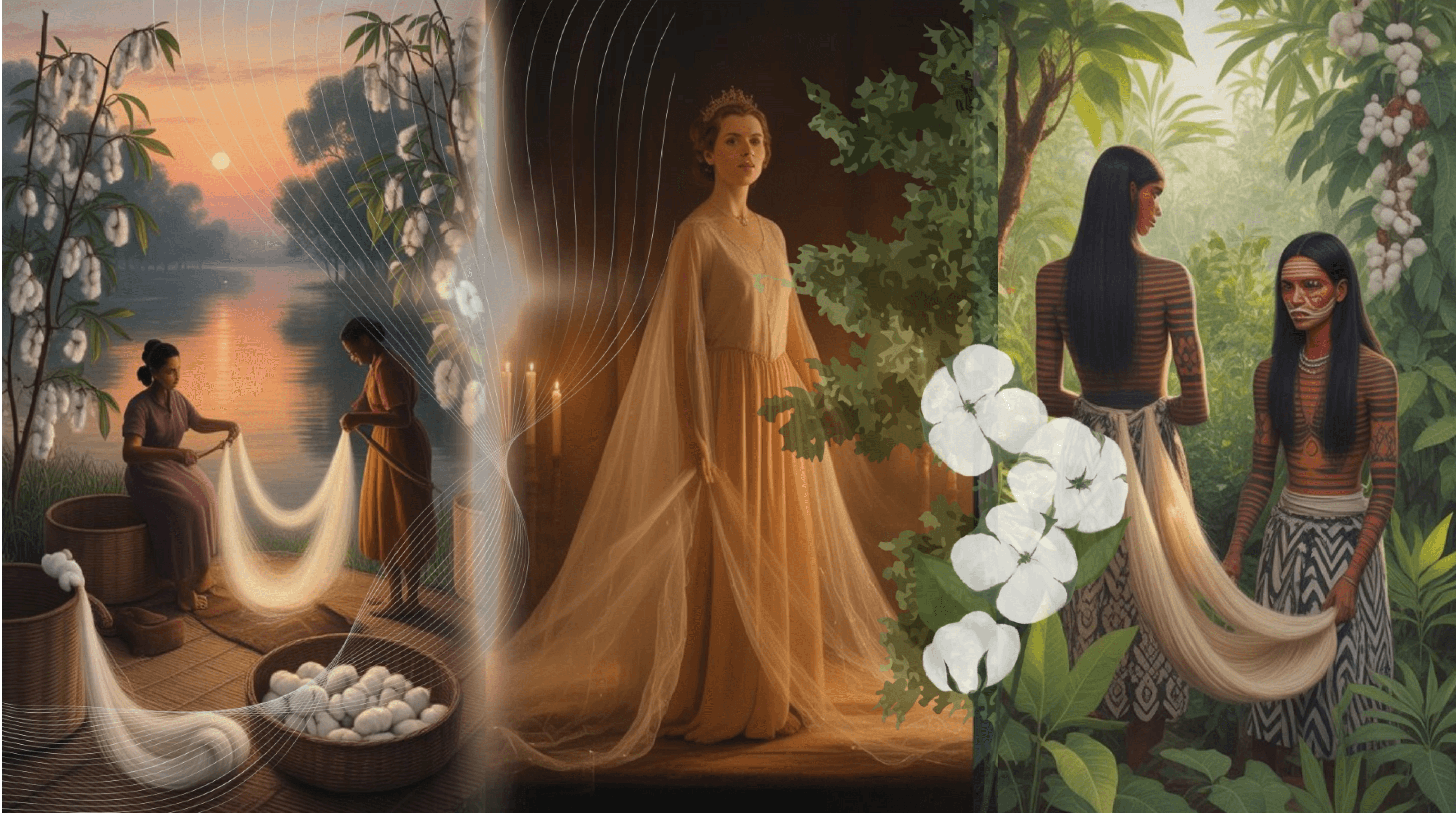
Prompt 1: “Ancestral Cotton Worlds: River Mist & Forest Textiles”
A cinematic split-scene illustration inspired by 18th-century Bangladesh on the left and pre-colonial Brazil on the right.
Left: humid riverbank at dawn where artisans harvest Phuti Karpas cotton; spinners working in morning mist; an aristocratic European woman in translucent Dhaka muslin, glowing in candlelight, symbolizing early global luxury shaped by fragile fibers.
Right: lush tropical forest gardens where Indigenous artisans cultivate native cotton in polycultures, weaving traditional garments with natural dyes.
Warm ochres, deep greens, high textile detail, poetic realism, atmospheric light.
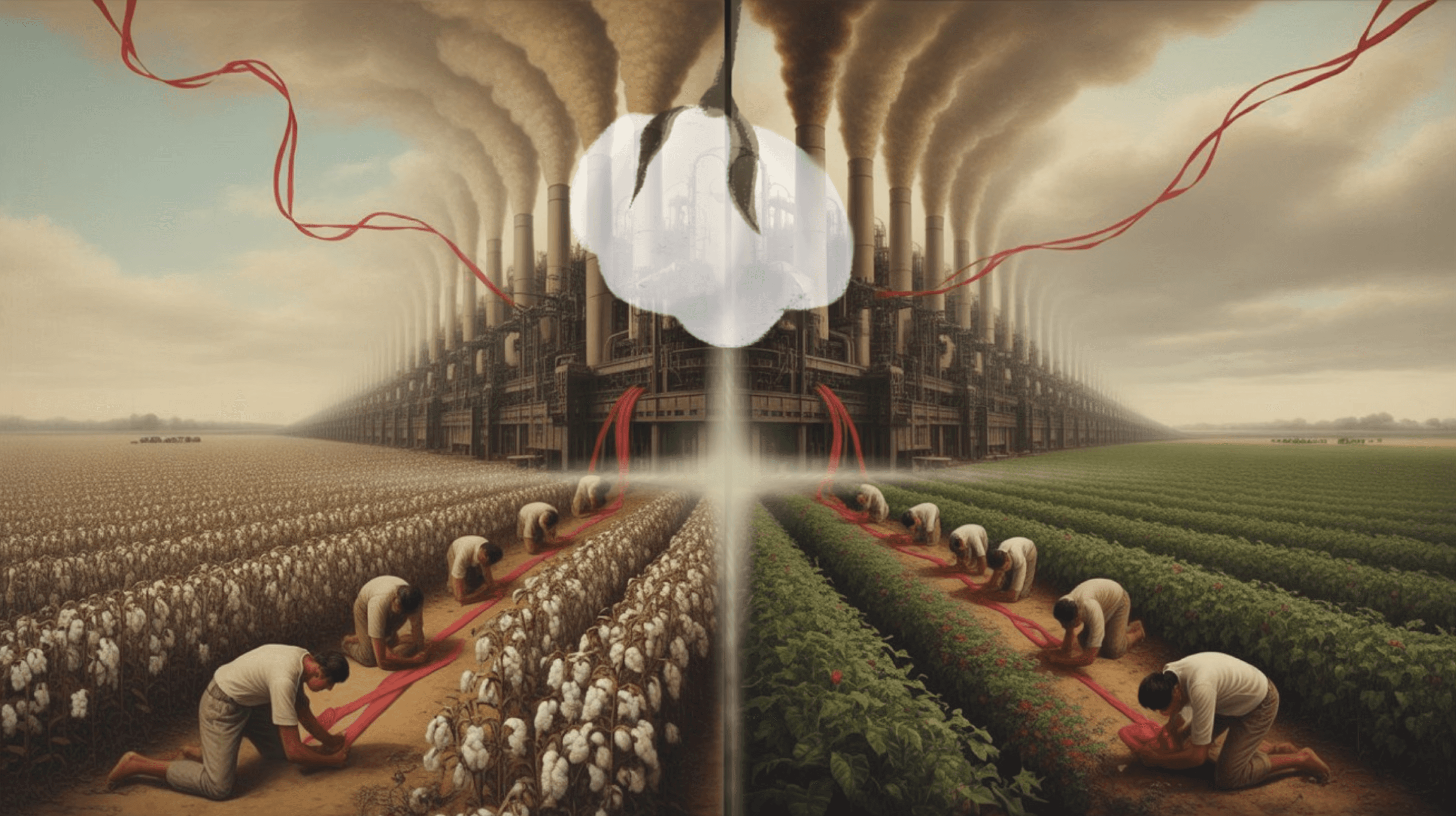
Prompt 2: “When the Thread Was Pulled Into the Machine”
A sweeping diptych representing colonial-era Bangladesh and Brazil shifting their cotton production for export. Fields once diverse now reorganized into large, pressured harvests.
A single tense red thread stretches from both sides toward the center, representing their blood, sweat and tears. Workers are kneeling in submission.
Center: towering English industrial textile machines, smokestacks, gears, mechanical looms devouring the thread.
Symbolism of globalization, extraction, and the redirection of entire cultures into the industrial core. Cinematic mood, muted industrial palette.
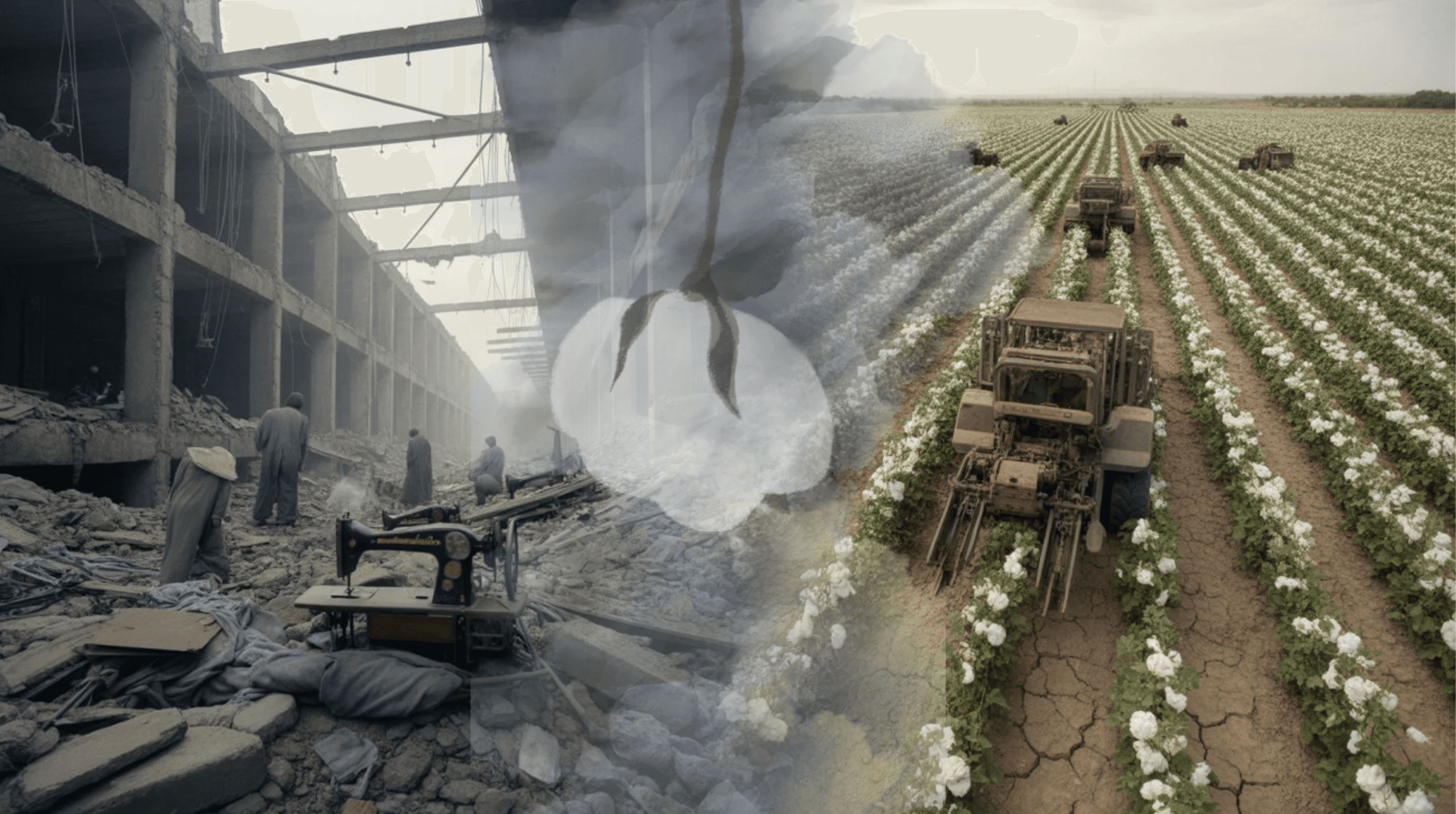
Prompt 3: “The Human Cost and the Endless White Field”
A powerful split-scene referencing Bangladesh and Brazil.
Left: the collapsed Rana Plaza rubble—broken concrete, fallen beams, abandoned sewing machines, ghostlike traces of workers; somber gray light.
Right: Brazil’s vast monoculture cotton plantations, uniform white rows extending to the horizon, cracked soil, pesticide haze, mechanical harvesters emphasizing lifeless uniformity.
Symbolism of human and ecological collapse within the same system.
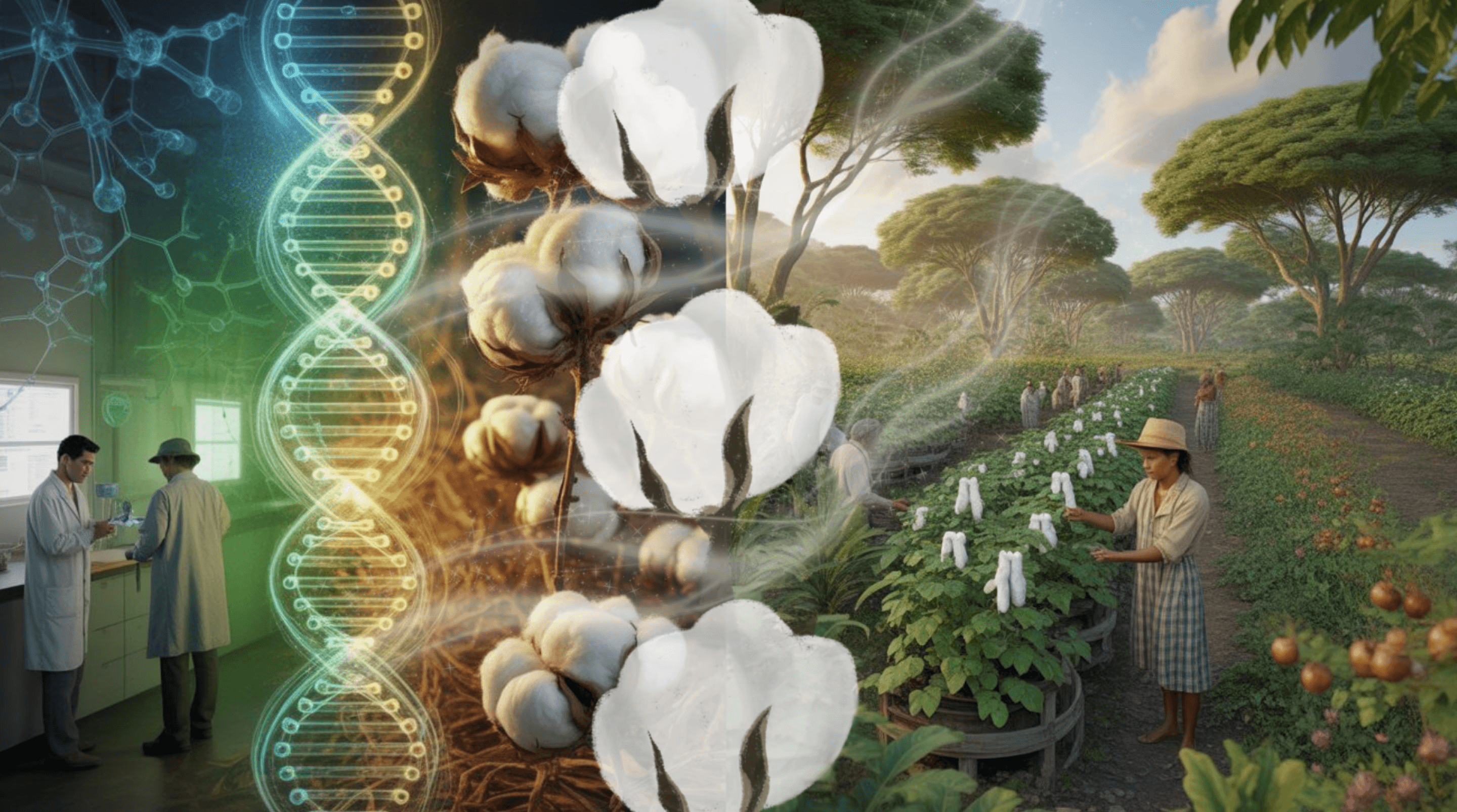
Prompt 4: “The Return of the Lost Thread”
A hopeful diptych tied to Bangladesh and Brazil.
Left: researchers reviving Phuti Karpas through DNA sequencing; glowing molecular spirals interwoven with ancient cotton fibers; a blend of science and memory.
Right: a vibrant Brazilian agroforest, organic cotton growing among trees, fruits, and native species, farmers cultivating biodiversity and ancestral knowledge.
Lush greens, luminous atmosphere, biocultural futurism.
Prompt 1: “Ancestral Cotton Worlds: River Mist & Forest Textiles”
A cinematic split-scene illustration inspired by 18th-century Bangladesh on the left and pre-colonial Brazil on the right.
Left: humid riverbank at dawn where artisans harvest Phuti Karpas cotton; spinners working in morning mist; an aristocratic European woman in translucent Dhaka muslin, glowing in candlelight, symbolizing early global luxury shaped by fragile fibers.
Right: lush tropical forest gardens where Indigenous artisans cultivate native cotton in polycultures, weaving traditional garments with natural dyes.
Warm ochres, deep greens, high textile detail, poetic realism, atmospheric light.
Prompt 2: “When the Thread Was Pulled Into the Machine”
A sweeping diptych representing colonial-era Bangladesh and Brazil shifting their cotton production for export. Fields once diverse now reorganized into large, pressured harvests.
A single tense red thread stretches from both sides toward the center, representing their blood, sweat and tears. Workers are kneeling in submission.
Center: towering English industrial textile machines, smokestacks, gears, mechanical looms devouring the thread.
Symbolism of globalization, extraction, and the redirection of entire cultures into the industrial core. Cinematic mood, muted industrial palette.
Prompt 3: “The Human Cost and the Endless White Field”
A powerful split-scene referencing Bangladesh and Brazil.
Left: the collapsed Rana Plaza rubble—broken concrete, fallen beams, abandoned sewing machines, ghostlike traces of workers; somber gray light.
Right: Brazil’s vast monoculture cotton plantations, uniform white rows extending to the horizon, cracked soil, pesticide haze, mechanical harvesters emphasizing lifeless uniformity.
Symbolism of human and ecological collapse within the same system.
Prompt 4: “The Return of the Lost Thread”
A hopeful diptych tied to Bangladesh and Brazil.
Left: researchers reviving Phuti Karpas through DNA sequencing; glowing molecular spirals interwoven with ancient cotton fibers; a blend of science and memory.
Right: a vibrant Brazilian agroforest, organic cotton growing among trees, fruits, and native species, farmers cultivating biodiversity and ancestral knowledge.
Lush greens, luminous atmosphere, biocultural futurism.
Prompt 1: “Ancestral Cotton Worlds: River Mist & Forest Textiles”
A cinematic split-scene illustration inspired by 18th-century Bangladesh on the left and pre-colonial Brazil on the right.
Left: humid riverbank at dawn where artisans harvest Phuti Karpas cotton; spinners working in morning mist; an aristocratic European woman in translucent Dhaka muslin, glowing in candlelight, symbolizing early global luxury shaped by fragile fibers.
Right: lush tropical forest gardens where Indigenous artisans cultivate native cotton in polycultures, weaving traditional garments with natural dyes.
Warm ochres, deep greens, high textile detail, poetic realism, atmospheric light.
Prompt 2—“When the Thread Was Pulled Into the Machine”
A sweeping diptych representing colonial-era Bangladesh and Brazil shifting their cotton production for export. Fields once diverse now reorganized into large, pressured harvests.
A single tense red thread stretches from both sides toward the center, representing their blood, sweat and tears. Workers are kneeling in submission.
Center: towering English industrial textile machines, smokestacks, gears, mechanical looms devouring the thread.
Symbolism of globalization, extraction, and the redirection of entire cultures into the industrial core. Cinematic mood, muted industrial palette.
Prompt 3—“The Human Cost and the Endless White Field”
A powerful split-scene referencing Bangladesh and Brazil.
Left: the collapsed Rana Plaza rubble—broken concrete, fallen beams, abandoned sewing machines, ghostlike traces of workers; somber gray light.
Right: Brazil’s vast monoculture cotton plantations, uniform white rows extending to the horizon, cracked soil, pesticide haze, mechanical harvesters emphasizing lifeless uniformity.
Symbolism of human and ecological collapse within the same system.
Prompt 4—“The Return of the Lost Thread”
A hopeful diptych tied to Bangladesh and Brazil.
Left: researchers reviving Phuti Karpas through DNA sequencing; glowing molecular spirals interwoven with ancient cotton fibers; a blend of science and memory.
Right: a vibrant Brazilian agroforest, organic cotton growing among trees, fruits, and native species, farmers cultivating biodiversity and ancestral knowledge.
Lush greens, luminous atmosphere, biocultural futurism.